
How to Check Criminal History in Hilliard
Start by identifying the record creator. The Town of Hilliard expressly identifies the Nassau County Sheriff’s Office as its law-enforcement provider. Town Hall keeps municipal administrative records, but it does not hold a deputy’s incident narrative, a jail booking, or a criminal docket. That division makes the first choice important: ask NCSO for a Sheriff’s report, use the jail inquiry for present custody, and search the Clerk’s OCRS system for a filed Nassau case.
- Confirm whether NCSO, Florida Highway Patrol, or another agency handled the event.
- Request the incident or arrest report from that agency, giving a case number, date, place, deputy, or involved name when known.
- Check the NCSO current-custody inquiry if the person may still be held in Yulee.
- Search Nassau OCRS for Circuit or County Court filings and dispositions.
- Add an FDLE CCHInet search when the question extends beyond Nassau County.
Hilliard Records Start With the Agency
A Hilliard street address does not, by itself, identify the custodian. NCSO handles ordinary town law enforcement, yet a highway crash or state investigation may belong to a different agency. The jail does not become owner of the arrest narrative merely because it accepts the person for booking. Before asking for a report, note the agency named on a citation, case card, crash exchange, or court docket.
For an NCSO event, the Sheriff’s Records Department accepts requests through its JustFOIA link, by phone at 904-548-4009, or at 77151 Citizens Circle in Yulee, weekdays from 8 a.m. to 5 p.m. The published aids include the case number, date and time, incident location, deputy, and involved person. Reports are listed at $0.15 per page, with added charges possible for certification, media, postage, or extensive service.
The Hilliard Police Department
There is no separate Hilliard Police Department to contact for current town law-enforcement records. The official town source states that NCSO provides service. Police-report requests therefore go to NCSO when a deputy handled the call. Hilliard Town Hall, at 15859 West County Road 108 and 904-845-3555, is the right source for town council, ordinance, and other municipal administrative records, not Sheriff case files.
This distinction prevents a common delay. A request sent to Town Hall for an arrest narrative must be rerouted because the town did not create that record. Conversely, an NCSO records request is not the right way to obtain a Hilliard council document. Name the event and desired record with care. Florida law does not require a requester to explain a purpose, but a narrow description helps the custodian find the correct file and estimate any charge.
Plan a Hilliard Records Counter Trip
Hilliard sits in northwest Nassau, while the Sheriff’s Records counter, jail, and full-service Clerk office are in Yulee. Call before making that trip. NCSO Records and the Clerk have different buildings, numbers, and files even though both are part of the county justice system. Sheriff’s headquarters is at Citizens Circle; the Clerk’s full-service counter is at 76347 Veterans Way.
The official Town of Hilliard website provides the municipal setting for the town offices shown here.
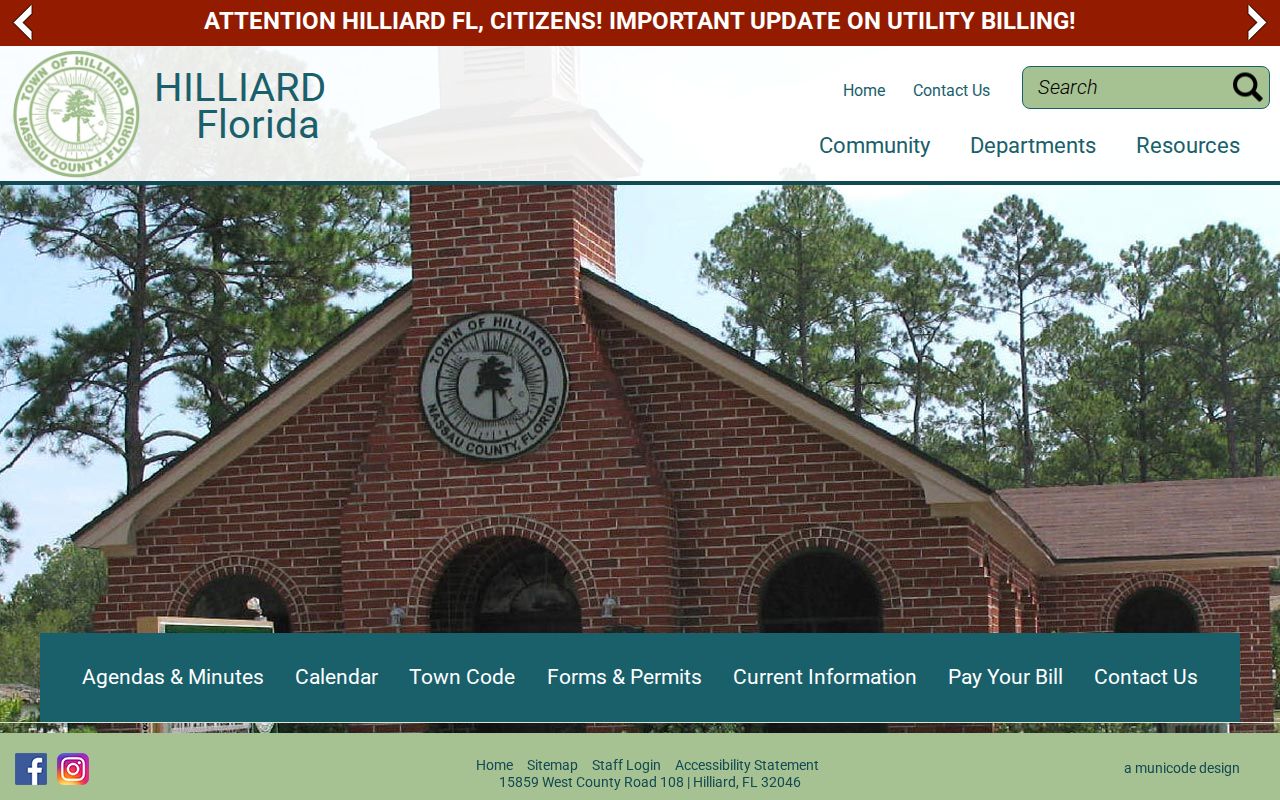
The image reinforces the custodian split: Town Hall is the local administrative counter, while criminal reports and bookings remain with NCSO.
Remote channels often resolve the first stage. OCRS public viewing does not require an account. NCSO’s request page opens an online public-record portal, and Records can confirm whether the office is the correct custodian. A phone check is especially useful when the arresting agency is uncertain or when a requester needs a certified copy, old report, or large media file.
Arrests and Bookings in Hilliard
A Hilliard arrest produces separate agency and custody files. The arresting officer creates an incident or arrest report, including the alleged facts and original charges. If booked locally, the Nassau County Jail and Detention Center in Yulee creates intake, identity, charge, bond, and custody entries. NCSO’s online inquiry is explicitly limited to people now in that facility.
A missing roster entry is not a finding that no arrest occurred. Release, transfer, a notice to appear, or a booking outside Nassau can all put the event beyond that current-custody view. Request older booking-related material from NCSO Records and look for a later court filing in OCRS. Charges shown at intake are allegations and may differ from the prosecutor’s filed counts. The Clerk’s docket is the better source for the case outcome.
Hilliard Arrest Report Versus Booking
The report explains why an officer acted. The booking entry documents jail intake. A court file records what prosecutors filed and how the judge resolved each count. Those records can share a date and name while still showing different charge wording, so match them with a report number, booking reference, or court case number rather than a name alone.
Use Nassau County arrest history for the county-wide request sequence. For a Hilliard event, keep the local focus on who made the arrest and whether custody is current. A person released yesterday may disappear from the live jail slice even though NCSO retains a report and OCRS later receives a case.
Hilliard Municipal Court Records
No verified separate Hilliard criminal-case portal or stand-alone municipal criminal court was found. Nassau Circuit Court hears felonies. Nassau County Court hears misdemeanors, criminal traffic, ordinances, and infractions. For an ordinance or citation, check the issuing document and ask the Town or Clerk which current channel applies before assuming Town Hall holds a criminal docket.
| Court Name | Nassau Circuit Court or Nassau County Court, depending on charge type |
|---|---|
| Case Types Heard | Circuit: felonies; County: misdemeanors, criminal traffic, ordinances, and infractions |
| Case Lookup Channel | Nassau Clerk OCRS, then the Clerk counter or phone for unavailable material |
| What the Docket Shows | Case number, court, parties, filed charges, events, status, disposition, and public documents when available |
| Copies & Fees | Published Clerk rates include $1 per page, $2 per certified document, and $2 per year for a manual search |
OCRS Holds Hilliard Court Cases
OCRS is the remote court-record path for Hilliard-related Nassau prosecutions. Public records can be viewed without registration. Search by case number when possible, or use party criteria and confirm the correct match through dates, court division, and charge details. Registered access may add criteria such as date range or case type, but it does not open confidential records.
If a recent arrest has no case yet, allow for the gap between arrest and prosecutorial filing. Then contact the Clerk at 904-548-4600 with the arrest date and any report or booking reference. Do not read an OCRS no-result as statewide clearance. The event might remain at the report stage, be filed under another name form, occur in another county, or be restricted from public view.
Where Hilliard Records End Up
An NCSO deputy’s report remains an NCSO record. A Nassau jail booking stays in the Sheriff’s custody system. If the State Attorney files charges, the Clerk creates the Circuit or County Court docket. Fingerprint-supported arrests and reported dispositions can then become part of FDLE’s statewide repository chronology.
Record flow: NCSO or actual arresting agency › Nassau County Courts › Florida Department of Law Enforcement
Timing explains many mismatches. The newest facts may exist only in the agency or jail system, while a final disposition appears later in OCRS and FDLE. For a fuller county overview, use the Nassau County criminal history routes. A repository result is not the same as the deputy’s narrative or the complete court jacket.
No Hilliard Result Is Not Statewide
NCSO’s $5 local check is a Nassau Sheriff product. It does not replace an FDLE Florida search. CCHInet Instant Search uses submitted identity details and costs $24 plus a $1 card-processing fee; the immediate result is not certified. FDLE also offers staff-conducted certified and non-certified products.
For your own record, FDLE Personal Review is the stronger audit and correction route because it uses fingerprints. FDLE does not charge for that review, though obtaining prints may carry a local cost. NCSO publishes $5 electronic fingerprint processing at headquarters and $5 ink cards at the detention facility, by appointment Tuesday through Friday. Confirm the required print method before traveling.
Hilliard Searches Near the Georgia Line
Hilliard’s northwest Nassau location makes jurisdiction limits easy to miss. OCRS covers Nassau filings, and FDLE CCHInet covers Florida repository data. Neither should be described as a search of Georgia court or agency records. A name can have records across a state line that do not appear in a county-only result.
The same boundary matters for registry awareness. The federal National Sex Offender Public Website searches participating jurisdictions and is a useful cross-state supplement near the Georgia line. For Nassau-specific registry detail, use the sex offender check. Registry information is for lawful safety use, not confrontation or harassment.
Public Access Rules
Florida provides broad access to nonexempt government records, but the correct custodian still controls the response. Hilliard handles town administrative material, NCSO reviews Sheriff reports, the Clerk applies judicial-record rules to court files, and FDLE disseminates repository information through its statutory products. A request need not use special words, be in writing, identify the requester, or state a purpose. The office may ask clarifying questions and may redact or withhold exempt content.
Juvenile records, sealed or expunged files, protected victim details, active investigative material, and sensitive identifiers can be restricted. Ask for the specific report, docket item, or date range. An arrest is not proof of guilt, and a dismissal does not automatically erase the underlying agency record.
Key Statutes:
Florida Public Records Law, Chapter 119 - requires prompt access to nonexempt records and permits lawful copy and extensive-use charges.
Florida Statutes § 943.053 - governs FDLE dissemination and public requests for criminal-history information.
Florida Rule 2.420 - governs public access and confidentiality for judicial-branch records.