
Criminal Cases in the Nassau County Courts
Nassau County sits in Florida's Fourth Judicial Circuit. Circuit Court hears felonies and juvenile delinquency matters. Nassau County Court handles misdemeanors, criminal traffic, county and municipal ordinances, and infractions. The Nassau Clerk Criminal Department maintains both sets of court records and collects the fines, fees, and assessments entered in those cases.
The full-service criminal counter is at 76347 Veterans Way in Yulee. The Fernandina Beach office at 416 Centre Street also provides clerk service, but a reader seeking an older or specific Nassau County criminal case should confirm where it can be reproduced before traveling. Court files are separate from the sheriff's arrest report and jail booking record. The clerk can certify a docket document; the arresting agency cannot.
The official Criminal Department source provides a useful view of this split. View the Nassau Clerk's criminal jurisdiction page before choosing a court division.
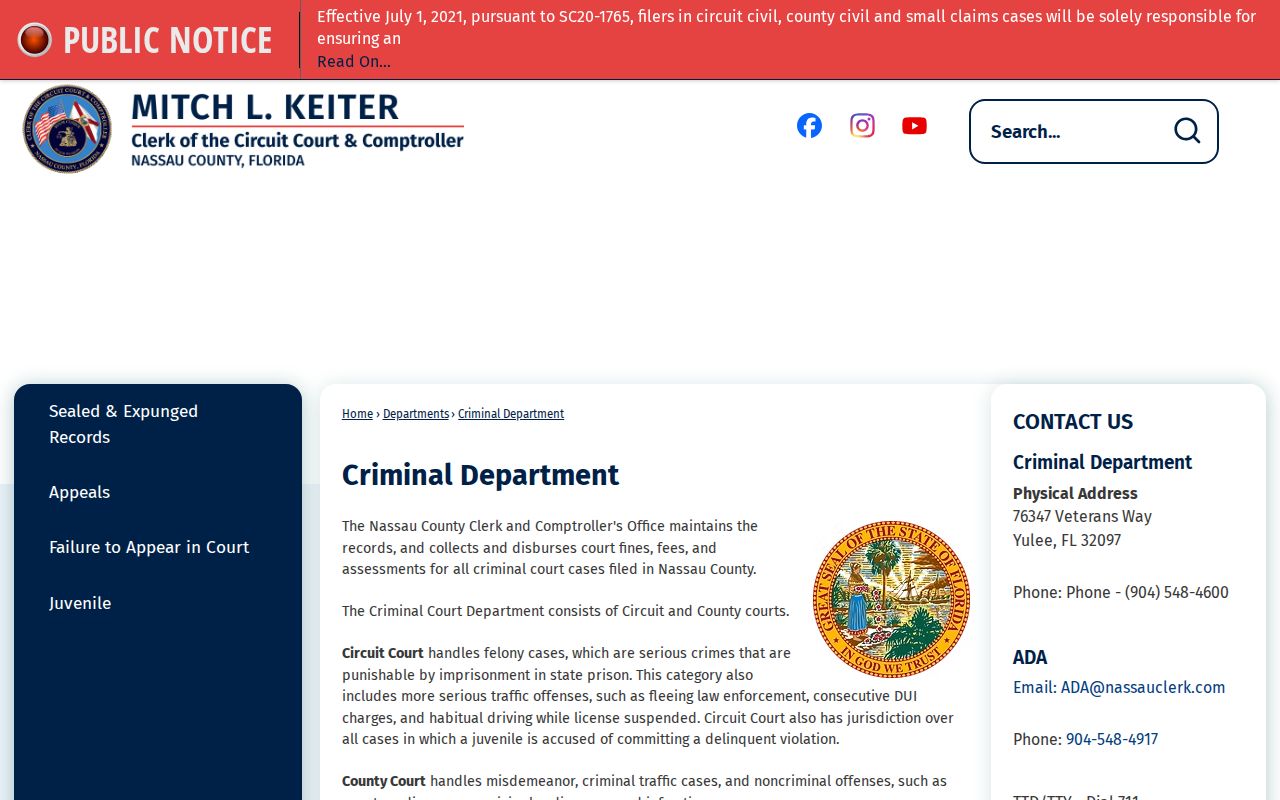
That source helps a searcher route a felony to Circuit Court and a misdemeanor or criminal traffic matter to County Court.
Nassau Criminal Cases in OCRS
OCRS Court Records Search is the main remote portal for Nassau County criminal case records. Public use does not require a login. A registration agreement sent to subscribers@nassauclerk.com can add search criteria, such as date range or case type, after stated processing of one to five business days. Registration does not unlock confidential material.
Open the Clerk Records Search source to reach OCRS and review the difference between public and registered access.
The image marks the official entry point, not a statewide trial-court database. Florida relies on county clerks for ordinary public case retrieval.
How to Search Case Records
Use a case number first when it is known. A name search can return people with similar names, so filing year, case type, court division, and other case metadata should be used to separate plausible matches. The Nassau County criminal docket should then be read from the case header through each charge and event, not from a single result label.
- Open the Nassau Clerk Records Search, select OCRS, and choose the relevant criminal division.
- Enter the full Nassau County case number. If it is unknown, search by the party name shown in the court file.
- Compare the filing date, case type, court, and status. Do not assume the first similar name is the right case.
- Open the summary and inspect charges, docket events, hearings, financial entries, and available document images.
- Ask the clerk for an absent image, older item, ordinary copy, or certified copy by case number and document title.
| Field Label | Type | Required | Notes |
|---|---|---|---|
| Case number | Text | No | Best exact-match field when known. |
| Party name | Text | No | Public search criterion; compare metadata carefully. |
| Date range | Date | Registered criteria | May be available under the subscriber agreement. |
| Case type | Select | Registered criteria | Helps narrow Circuit or County criminal results. |
| Filing year | Date/year | No | Confirm against the case header after opening a result. |
Nassau Court Records at Veterans Way
The Yulee clerk office is the practical center for Nassau County criminal court cases. It serves Circuit and County matters at 76347 Veterans Way, Yulee, FL 32097, and can be reached at 904-548-4600. The Fernandina Beach counter is at 416 Centre Street, 904-491-6430. Its current notice limits in-person staffing to Thursdays, with a midday closure, so confirm service before a trip.
Nassau Clerk Criminal Department
76347 Veterans Way
Yulee, FL 32097
904-548-4600
Full-service Circuit and County criminal records counter.
For remote forms, calendars, payment tools, and record links, review the Clerk's Online Resources.
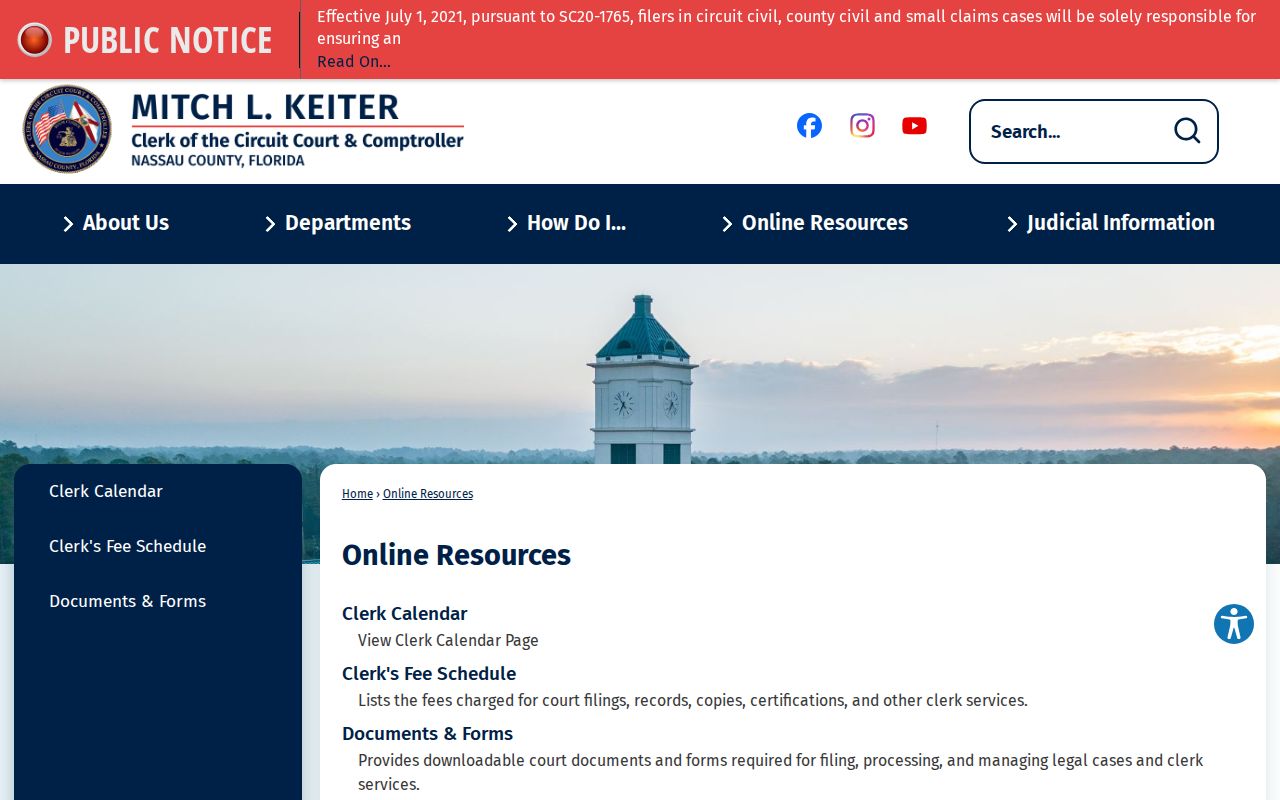
The online resources page complements OCRS when a search leads to a calendar, payment, or clerk form rather than a docket image.
What the Case File Shows
A Nassau County case file centers on a local case number, court division, parties, charges, docket entries, and orders. The header gives the filing date, type, and current status. Charge rows may list separate counts, statutes, degrees, and outcomes. The docket is the time-ordered index of notices, hearings, motions, pleas, warrants or capias entries, judgment, sentence, and costs.
| Case Number & Court | Identifies the Nassau case, division, type, filing date, and status. |
|---|---|
| Charging Document | The information or indictment states the charge filed for prosecution. |
| Docket Entries | Chronological list of filings, notices, motions, pleas, orders, and costs. |
| Hearing Dates | Event type, date, time, location, division, and judicial officer when populated. |
| Disposition & Judgment | Outcome for the case or for each count, which can differ. |
| Sentence & Conditions | Custody, probation, restitution, fines, and other court-ordered terms where public. |
Nassau Criminal Case Outcomes
Outcome words are not interchangeable. A Nassau County criminal case can contain several counts, and each count may end in a different way. Read the disposition beside the matching charge rather than treating the overall case status as the result of every allegation.
- Nolle prosequi
- The prosecutor formally chose not to continue that charge.
- Dismissal
- The court ended a charge without a conviction on it.
- Withhold of adjudication
- Florida withheld formal adjudication after a plea or finding; it is not a dismissal.
- Adjudication
- The court entered a judgment of guilt or another legally stated result.
- Acquittal
- A not-guilty decision after trial.
Note: The arrest charge may change after review, so the filed information and charge-level disposition control the court record.
Stages of a Criminal Case
A custodial arrest is followed by first appearance, where a judge reviews probable cause and release conditions. The prosecutor then decides what to file. A felony may proceed by information or, where applicable, grand jury indictment. Arraignment records the plea. Discovery and motions shape the pretrial phase before a negotiated plea or trial produces a judgment and sentence.
Case flow: Charges Filed › Arraignment › Pretrial › Plea or Trial › Disposition › Sentencing
An appeal or postconviction proceeding may add later docket entries. The Nassau County arrest history remains a separate agency and custody trail, even when OCRS later shows the related prosecution.
Nassau Criminal Record Copy Fees
Remote viewing is not the same as obtaining an official copy. The Nassau Clerk lists ordinary copies at $1 per page, certification at $2 per document, and a record search at $2 for each year searched. An exemplified certificate is $7. Ask which form is needed before ordering because certification and exemplification serve different purposes.
Check the current Nassau Clerk fee schedule before submitting payment.
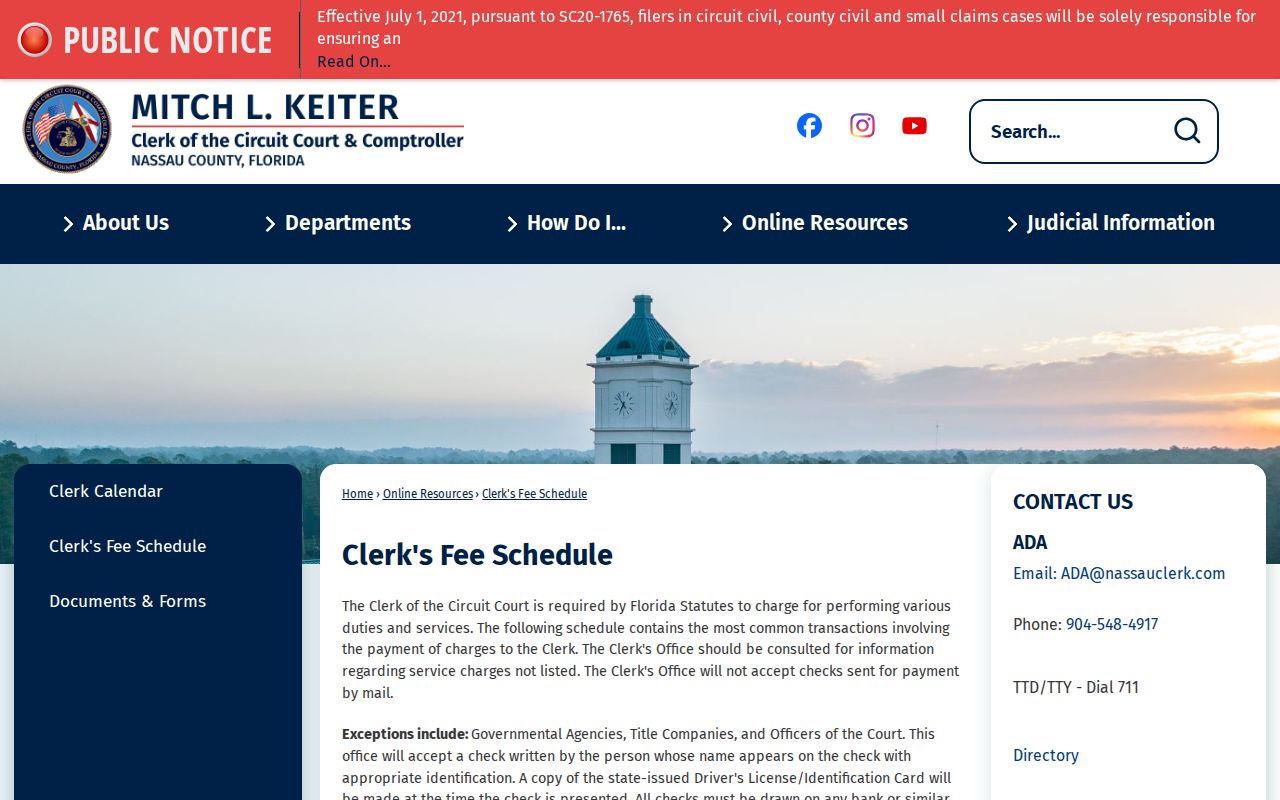
The source also lists $42 for sealing a court file or expungement service, a separate court-record task from a basic copy request.
When Nassau Docket Images Are Restricted
A missing image does not prove that a Nassau County criminal filing does not exist. Docket-linked images depend on their public-access class. Protected identifiers, victim or minor information, juvenile matters, sealed or expunged files, and other confidential categories can be redacted or unavailable. Florida Rule of General Practice and Judicial Administration 2.420 governs judicial-record access.
Write down the case number, docket date, and document title. Contact the clerk and ask whether the item can be inspected, copied with redactions, or is confidential. The official Florida Courts judicial-record access source explains the statewide framework.
That framework explains why registered OCRS access can add search tools without exposing a record that the law makes confidential.
Access & Restrictions
Florida law starts with broad access, but court records follow judicial rules as well as constitutional and statutory limits. The public may inspect available Nassau County criminal case records without stating a purpose. A clerk may still redact protected data or withhold a confidential case category. Active-investigation records held by police are also not the same file as an open court docket.
Florida Public Records Law governs agency records, while Rule 2.420 governs judicial records. Juvenile, victim, sealed, expunged, and protected identifying information may be restricted.
For a case absent from OCRS, call the Yulee clerk at 904-548-4600 and give the case number or the best name and filing-year details available. Request the exact document, not a broad narrative about the person. That approach reduces search cost and helps the clerk identify whether the file is public, archived, or restricted.