
How to Check Criminal History in Fernandina Beach
Start a Fernandina Beach criminal history check with the office that made the record. Fernandina Beach Police holds reports written by its officers. The Nassau County Sheriff's Office, or NCSO, controls the county jail record after a booking. The Nassau Clerk maintains a filed criminal case in OCRS Court Records Search. The Florida Department of Law Enforcement, or FDLE, supplies the statewide criminal-history layer.
Names alone can produce weak matches. Gather the report number, event date, incident location, full name, date of birth when lawfully available, and any court case number. A report number helps city police. A booking date helps NCSO. A case number is the cleanest route through OCRS.
- Ask Fernandina Beach Police for the incident or arrest report.
- Give the event date, place, report number, and exact record type.
- Check NCSO current custody, or request an older booking record.
- Search Nassau OCRS for ordinance, traffic, misdemeanor, or felony filings.
- Add FDLE CCHInet when the question extends across Florida.
Fernandina Beach Records Cross the Island
Fernandina Beach is Nassau County's seat, yet much of the working criminal-record system sits inland in Yulee. A city officer may write a report on Amelia Island, but a person taken into custody is booked at the Nassau County Jail and Detention Center in Yulee. If prosecutors file a charge, the court file is maintained through the Nassau Clerk. The record moves by function, not by city boundary.
The historic Clerk office at 416 Centre Street remains a service point, but it is not the county's only court-record counter. The full-service Clerk office is at 76347 Veterans Way in Yulee. Before making a trip, call the Fernandina counter at 904-491-6430 and ask whether it can reproduce the exact case document. Its published notice limits current in-person staffing to Thursdays, 9 a.m. to 4 p.m., with a closure from 11:30 a.m. to 12:30 p.m. Confirm those hours before travel.
The Fernandina Beach Police Department
The Fernandina Beach Police Department at 1525 Lime Street keeps reports made by city officers. Administrative and records hours are Monday through Friday, 8 a.m. to 5 p.m. The main number is 904-277-7342. Public-record custodian Stephanie Delaney may be reached at 904-310-3207. Ask for the exact product, since a report, dispatch record, body-camera file, and crash record are not one combined file.
The official Fernandina Beach JustFOIA request form offers a direct city channel. The source page shown below is the request entry point.
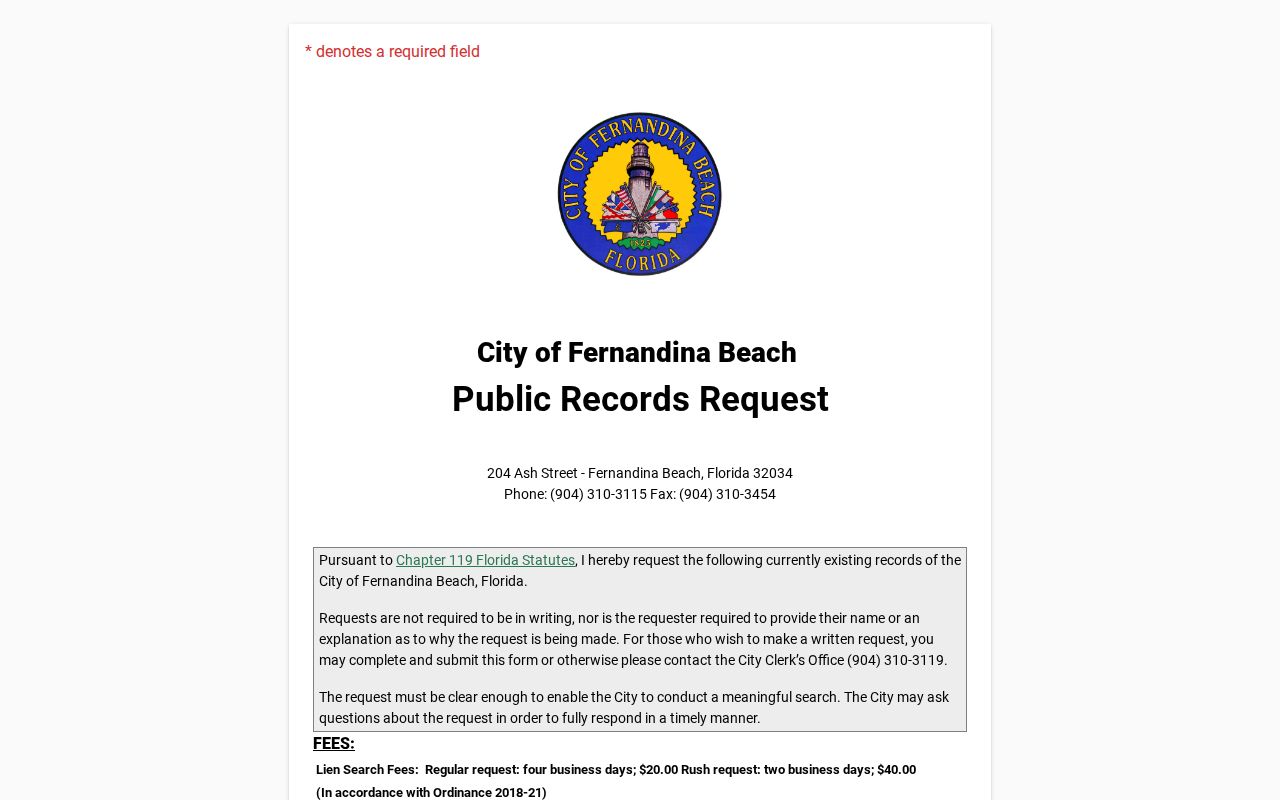
The image reinforces the key distinction: use the city route for a Fernandina Beach police report, not Nassau County's general Records Management office. State the format and identify whether the request concerns a written narrative, 911 or CAD data, body-camera video, or another file. Exempt details can be redacted.
Request Exact Fernandina Beach Police Records
A precise request saves time. Give Fernandina Beach Police any known report number, the date and approximate time, the incident location, the officer's name if known, and the names tied to the event. Describe the record itself. “Incident report” is clearer than “everything on a person,” and “body-camera video from a named event” is clearer than “all video.”
For a crash investigated by city police, follow the crash channel linked by FBPD. Florida crash reports can have access limits during the statutory confidential period. For a criminal case outcome, move to OCRS. For jail intake, move to NCSO. The city custodian cannot certify a county court disposition or recreate a jail booking record.
Note: A well-scoped request identifies the event and file type without demanding unrelated records from the wrong custodian.
Arrests and Bookings in Fernandina Beach
A Fernandina Beach arrest produces separate records. The police report stays with FBPD. Booking and custody entries belong to NCSO because the county jail is in Yulee. The official NCSO current-custody inquiry displays only people held now. Release or transfer can remove an entry, so an empty result does not prove that no arrest occurred.
For an older booking, contact NCSO Records at 904-548-4009 or visit 77151 Citizens Circle in Yulee during published Monday through Friday, 8 a.m. to 5 p.m. counter hours, excluding holidays. Ask for booking-related material or an arrest report created by an NCSO deputy. If FBPD made the arrest, return to the city for its narrative.
An arrest charge is an allegation, not a conviction. The State Attorney decides what to file, and OCRS records the prosecution. Compare dates, count numbers, and case identifiers instead of assuming police, jail, and court wording will match.
Missing Fernandina Beach Booking Records
When a person no longer appears in current custody, use the event date to work backward. First ask FBPD for the city arrest report. Next ask NCSO Records for older booking material. Then search OCRS for a filed case. A release, transfer, citation, or decision not to file can explain why one system has a record while another does not.
The sources can also use different dates. The incident may begin one day, booking may occur later, and prosecutors may file afterward. Search a reasonable date window and compare the case number with the police report number. They are not always the same. The Nassau County arrest history resource provides fuller county custody and request details.
Fernandina Beach Municipal Court Records
No verified separate Fernandina Beach criminal-case portal was found. Nassau County Court handles misdemeanors, criminal traffic, municipal ordinances, and infractions. Circuit Court handles felonies. Use the Nassau Clerk Records Search page to enter OCRS, or ask a Clerk counter about the citation or case number. Public OCRS use needs no account. Registration can add search criteria or authorized role access, but it does not expose confidential records.
| Court Name | Nassau County Court or Circuit Court. |
|---|---|
| Case Types Heard | Misdemeanors, traffic, ordinances and infractions in County Court; felonies in Circuit Court. |
| Case Lookup Channel | Nassau OCRS or a Clerk counter. |
| What the Docket Shows | Filed charges, events, documents, outcome, sentence, and public financial entries. |
| Copies & Fees | $1 per page, $2 per certified document, and $2 per search year. |
Open the case summary and review each count. An arrest description can change when prosecutors file an information. The docket may show arraignment, motions, hearings, plea or trial events, judgment, sentence, financial entries, and public document images. A “nolle prosequi” entry means the prosecution chose not to proceed on that count. It is not the same as an acquittal, and neither result automatically erases the city police report.
Fernandina Beach Court Records on Centre Street
The Centre Street Clerk office is useful, but its location can foster a bad assumption: county-seat status does not mean every modern criminal-record function is concentrated there. The island counter and full-service Yulee office are parts of the same Clerk system. Detention and Sheriff's Records remain in Yulee.
Call before requesting an older file or certified copy at Centre Street. Give the case number and document title when possible. The published Clerk schedule lists ordinary copies at $1 per page, certification at $2 per document, and a record search at $2 per year. Certification confirms the copy came from the Clerk; it does not merge the court file with the underlying police narrative. The Nassau County criminal court cases page provides detailed docket guidance.
Where Fernandina Beach Records End Up
Fernandina Beach Police creates the agency report. NCSO adds booking and custody data when the person enters the county jail. Nassau courts add filed charges and a disposition. Reportable arrest, court, and corrections events then feed Florida's central repository, subject to reporting rules and timing.
Record flow: Fernandina Beach Police › Nassau County Jail › Nassau County Courts › Florida Department of Law Enforcement
Use FBPD for the incident narrative, NCSO for county custody records, OCRS for the filed case and outcome, and FDLE for the reportable statewide chronology. One source cannot safely stand in for the others.
FDLE Fernandina Beach Criminal Records
Add FDLE when a search must extend beyond the city or Nassau County. The FDLE Florida Checks program offers CCHInet Instant Search and staff-conducted certified or non-certified searches. Instant Search costs $24 plus a $1 card-processing fee. A state history is not a copy of every local incident report, and sealed or expunged material is excluded from ordinary public release.
For review of your own Florida repository record, FDLE Personal Review is the stronger channel. It uses fingerprints taken by a law-enforcement or criminal-justice agency and mailed with the state form. FDLE charges no fee for Personal Review. That process also supports a challenge when a repository entry is inaccurate or incomplete. Trace a mismatch back to the agency that supplied the event.
Public Access Rules
Florida public-record requests need no magic phrase, written form, stated purpose, or requester identity. Ask the correct Fernandina Beach custodian and describe the record well enough to locate it. An agency can clarify scope and charge lawful copy or extensive-use costs. It must review material for exemptions rather than treat every police or court record as fully open.
Key Statutes:
Florida Public Records Law, Chapter 119 governs access to nonexempt agency records.
Florida Statutes §943.053 governs FDLE criminal-history dissemination.
Florida Rule 2.420 governs judicial-record access and confidentiality.
Victim information, juvenile files, active criminal intelligence or investigation material, sealed or expunged records, and protected identifiers can be withheld or redacted. Court records follow judicial access rules, while city police reports follow agency public-record rules. FDLE history uses its statutory paid product rather than a general Chapter 119 request intended to bypass the search fee.
Fernandina Beach Record Terms Compared
Several records can describe the same event without being duplicates. The incident report states what city police documented. The booking entry records intake and custody. The court docket shows what prosecutors filed and what the judge or jury resolved. FDLE collects reportable events from across Florida.
- Incident report
- The Fernandina Beach Police narrative and related agency material from a reported event.
- Arrest report
- The arresting agency's account of probable cause and the arrest action.
- Booking record
- NCSO jail intake, charge, bond, and custody information created after admission.
- Court docket
- The Clerk's list of filed charges, hearings, documents, disposition, and sentence.
- State criminal history
- FDLE's chronology of reportable Florida criminal-justice events tied through repository matching.
A dismissal changes the court outcome but does not by itself destroy a city police report. Sealing and expunction require a separate Florida process. When two official files conflict, compare identifiers and dates, obtain certified disposition records, and use the official correction or Personal Review channel.
Timing explains many gaps. A police report can exist before a prosecutor opens a court case. A jail entry may disappear from the current-custody screen after release. The Clerk cannot show a disposition until the court acts, and the FDLE chronology depends on reportable data reaching the repository. Check the source closest to the event first, then return to the later systems after enough time has passed for filing and reporting.
Identity checks matter as much as timing. Common names can create false matches, while spelling changes can hide a valid file. Compare birth data, middle names, event dates, case numbers, and agency identifiers where those details are lawfully available. Do not treat a name-only result as proof that every entry concerns the same person. For your own statewide record, fingerprint-based Personal Review supplies a sound basis for a formal correction request.