
How to Check Criminal History in Callahan
The Town of Callahan is the source for municipal administrative records, but its current site lists no police department. Law-enforcement reports generally route to the Nassau County Sheriff’s Office. Begin with the officer’s agency, not the town name in an address. A highway event may belong to Florida Highway Patrol or another state unit.
- Identify NCSO or the other investigating agency from a citation, report receipt, or docket.
- Request that agency’s report with the case number, date, place, and officer when known.
- Use the NCSO inquiry only for current custody.
- Search Nassau OCRS for filed Circuit or County Court cases.
- Add FDLE CCHInet for the Florida repository layer.
Who Polices a Callahan Address?
NCSO is the documented local law-enforcement route. That does not make every event near Callahan an NCSO file. The U.S. 1 and U.S. 301 crossroads can involve state, county, or other authorized officers. The agency named on the paperwork is the best custodian clue.
For an NCSO event, the Records Department offers a JustFOIA link, a counter at 77151 Citizens Circle in Yulee, and phone help at 904-548-4009. Reports are listed at $0.15 per page. Certification, postage, media, and extensive work may cost more. Give the case number, date, location, deputy, or involved name when available.
The Callahan Police Department
Callahan’s official website does not list a municipal police department. Do not search for a separate current Callahan police records unit. NCSO is the report route when its deputies respond. The town clerk instead holds Callahan’s own administrative records at 542300 U.S. Highway 1, Callahan, FL 32011.
Town Clerk Shawna Gugliuzza may be reached at 904-879-3801 or clerk@townofcallahan-fl.gov for town material. That office does not replace NCSO Records, the jail, or the Clerk of Court. Sending the request to its true creator avoids delay.
Find the Callahan Investigating Agency
A report number, citation, arrest date, intersection, officer, or court number can identify the responsible agency. If none is known, call NCSO Records before driving east to Yulee. Describe the date and place so staff can confirm whether an NCSO file is likely.
The highway setting is a jurisdiction clue, not proof of crime. Official crime claims require a named year and FDLE or FBI source. Callahan has no municipal police reporting series. An absent town row therefore cannot be converted into “zero crime.”
Arrests and Bookings in Callahan
The officer’s agency creates the arrest narrative. If the person enters the Nassau County Jail and Detention Center, NCSO creates the booking photo, fingerprints, intake charges, bond entries, and custody status. These are related but separate files. The online jail inquiry is explicitly limited to people now held there.
Release, transfer, or a notice to appear can put an event outside that live view. Request older material from NCSO Records. Search OCRS for filed charges, hearings, and outcomes. Intake charges are allegations and can change after the State Attorney reviews the matter.
Western Nassau Arrest, Yulee Booking
Callahan lies in western Nassau, while the county jail and records complex are in Yulee. Search current custody before traveling, then call Records if the person is absent. The live roster was not built as an arrest archive.
Use Nassau arrest history for the county-wide process. For Callahan, remember the ownership split: the investigating agency holds the report, NCSO holds a Nassau booking, and the Clerk holds the criminal case.
Callahan Municipal Court Records
No verified independent Callahan criminal-case portal or separate Callahan felony court was found. Nassau Circuit Court hears felonies. Nassau County Court hears misdemeanors, criminal traffic, ordinances, and infractions. For a town citation, follow the issuing document and confirm the current channel with the town or Clerk.
| Court Name | Nassau Circuit Court or Nassau County Court, based on the charge |
|---|---|
| Case Types Heard | Circuit felonies; County misdemeanors, criminal traffic, ordinances, and infractions |
| Case Lookup Channel | Nassau OCRS, then Clerk phone or counter help for missing items |
| What the Docket Shows | Case number, parties, charges, events, status, disposition, and available public documents |
| Copies & Fees | $1 per page, $2 per certified document, and $2 per year searched under published rates |
Callahan Citation Versus Criminal Case
A town ordinance citation is not automatically a misdemeanor. A traffic matter can also be civil or criminal. Read the cited provision and named court instead of guessing from the location. Use the citation number when contacting the town or Clerk.
In OCRS, inspect each count and disposition. Dismissal, nolle prosequi, withhold of adjudication, and adjudication have different meanings. A filed court charge may differ from the arrest charge, so the later docket should control any statement about outcome.
Where Callahan Records End Up
The investigation remains with NCSO or the actual agency. A county booking stays with NCSO. If prosecutors file charges, the Nassau Clerk creates the docket. Fingerprint-supported arrests and dispositions may then reach FDLE’s repository.
Record flow: NCSO or actual investigating agency › Nassau County Courts › Florida Department of Law Enforcement
Use the report for the officer’s account, custody search for current detention, OCRS for filed counts and outcomes, and FDLE for a Florida history product. The Nassau County criminal history overview links those broader layers.
Use OCRS From Western Nassau
Public OCRS viewing requires no account. Search by case number where possible. A name search needs confirmation through dates, division, and charge details. Registration may add criteria, but it cannot expose confidential documents.
A new arrest may not appear until prosecutors file. If no case appears, contact the Clerk at 904-548-4600 with the arrest date and any report or booking reference. Do not treat the gap as proof that no case exists.
Once a case opens, the public summary can show its number, filing date, court division, parties, charges, events, financial entries, and disposition. Public document images depend on the access classification. Protected identifiers, juvenile material, victim information, and confidential filings may not display. A blank image link can therefore reflect an access rule rather than a missing case.
The official Callahan website supplies the municipal context shown here.
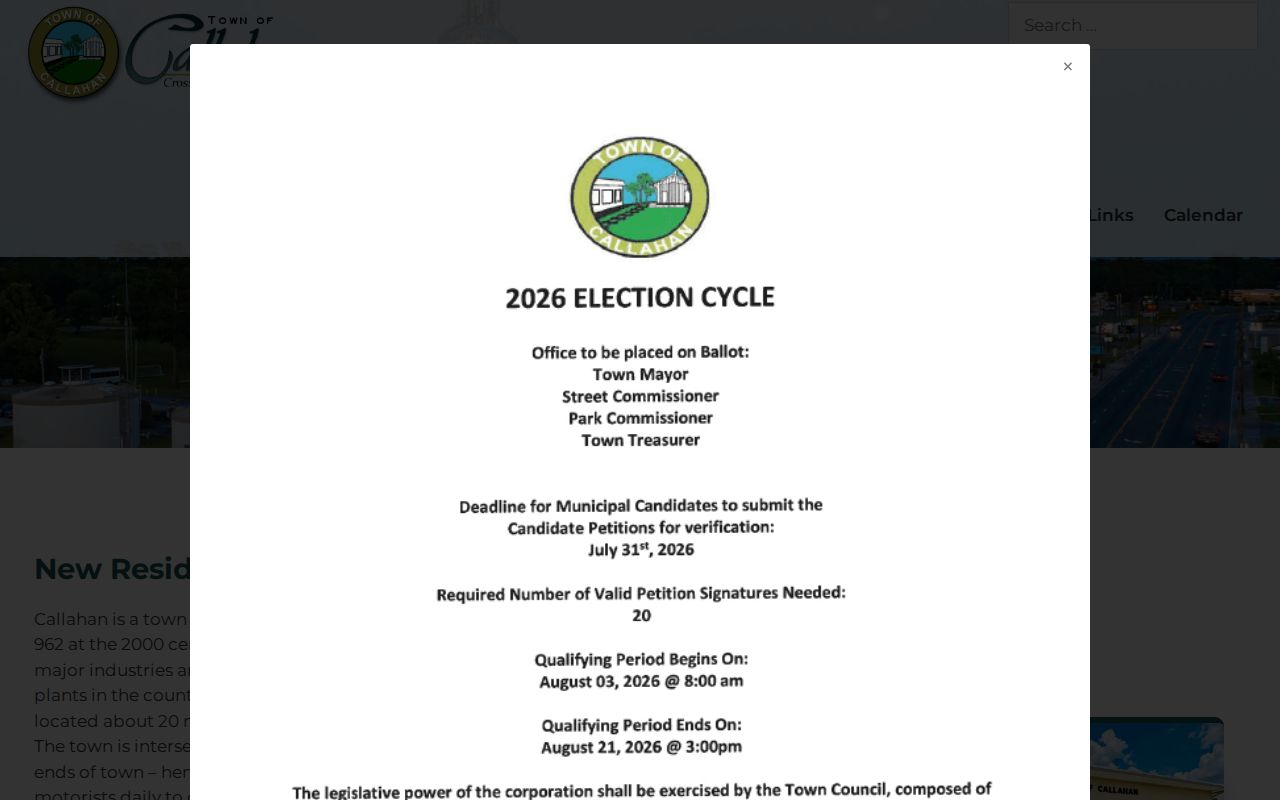
Town Hall is distinct from the Yulee justice complex that keeps Sheriff and court criminal records.
Callahan Local Check Versus State Search
NCSO’s $5 local check is a Sheriff product covering its Nassau records, not a full Florida history. FDLE CCHInet Instant Search costs $24 plus a $1 card fee. It returns a public state repository result, but it is not certified and name matching is not fingerprint identification.
For your own record, FDLE Personal Review is free from FDLE, uses fingerprints, and provides a challenge route. NCSO offers $5 electronic processing at headquarters and $5 ink cards at the detention center by appointment Tuesday through Friday. Confirm the required print method first.
The local and state products also describe different record sets. An NCSO check cannot supply a complete file from another Florida county. An FDLE history may show reportable arrest and disposition events, but it is not the deputy’s full narrative or the Clerk’s complete docket. Compare identifiers and dates, then return to the originating office for the source document.
When Current Callahan Custody Is Too Narrow
The jail inquiry answers a present-tense question: who is held at the Nassau facility now. It is useful soon after a Callahan-area arrest, but it is not designed to list everyone previously booked. A release, transfer, or noncustodial citation can produce a no-result even when an official report exists.
Build a historical answer from the records that last. Call NCSO Records for the arrest or older booking material. Search OCRS for the prosecution and final count outcomes. If the event could fall outside Nassau, add FDLE’s statewide product. This layered method is slower than relying on one roster, but it avoids turning a limited custody snapshot into an unsupported claim about a person’s past.
Keep the reference numbers from each office. They make later copy requests and record comparisons far more precise.
Public Access Rules
Florida law gives access to nonexempt public records, but each custodian answers for its own files. Callahan handles town records, NCSO handles Sheriff reports, the Clerk handles judicial files, and FDLE uses its criminal-history products. A requester need not identify themselves, state a purpose, use magic words, or make the request in writing.
Juvenile, sealed or expunged, active-investigation, victim, and sensitive identity material may be restricted. Court files follow judicial-access rules. Ask for a specific report or docket item, and never treat an arrest as proof of guilt.
Key Statutes:
Florida Public Records Law, Chapter 119 - provides access to nonexempt records and allows lawful copy and extensive-use charges.
Florida Statutes § 943.053 - controls FDLE criminal-history dissemination.
Florida Rule 2.420 - governs access and confidentiality in court records.