
How to Check Criminal History in Nassau County
No single official search produces every Nassau County criminal record. Start with the source closest to the event, then compare it with the next stage of the case. Have the full name, spelling variants, an approximate date, and any case or booking number ready. A name alone can point to the wrong person, so confirm a likely match with a case number and other nonsensitive details.
- Open the Nassau Clerk Records Search page and use OCRS for filed Circuit or County Court cases.
- Check the NCSO Current-Custody Inquiry if the person may be held in the county detention facility now.
- Ask the arresting agency for its report. Call NCSO Records at 904-548-4009 for Sheriff's incidents.
- Use FDLE CCHInet when a statewide Florida repository return is needed.
- Contact the Clerk for older material, copies, certification, or a manual search that the online view does not supply.
Four Nassau Criminal Records, Four Answers
OCRS, the NCSO jail inquiry, an agency report, and FDLE answer different questions. The court file shows what prosecutors filed and how the judge resolved it. The jail inquiry describes current Nassau custody. An arrest report records the officer's account and initial allegation, while FDLE assembles a statewide chronology from agency, fingerprint, court, and corrections reporting.
The systems update on different schedules. An arrest may precede a filed case, a prosecutor may alter charges, and release from jail can remove a name from a current-custody result.
Official Florida Background Checks
The Florida Department of Law Enforcement, Division of Criminal Justice Information Services, keeps the central state repository. Its Florida criminal-history check options include CCHInet Instant Search, staff-conducted certified or non-certified searches, and ORI-controlled searches. Instant Search costs $24 plus a $1 card-processing fee and returns an immediate, non-certified result. A staff search costs $24; FDLE lists about five business days for non-certified processing and six to seven business days for certified processing, excluding mail time.
The official overview below shows why the state channel is broader than a Nassau local check but still does not replace the Clerk's case documents.
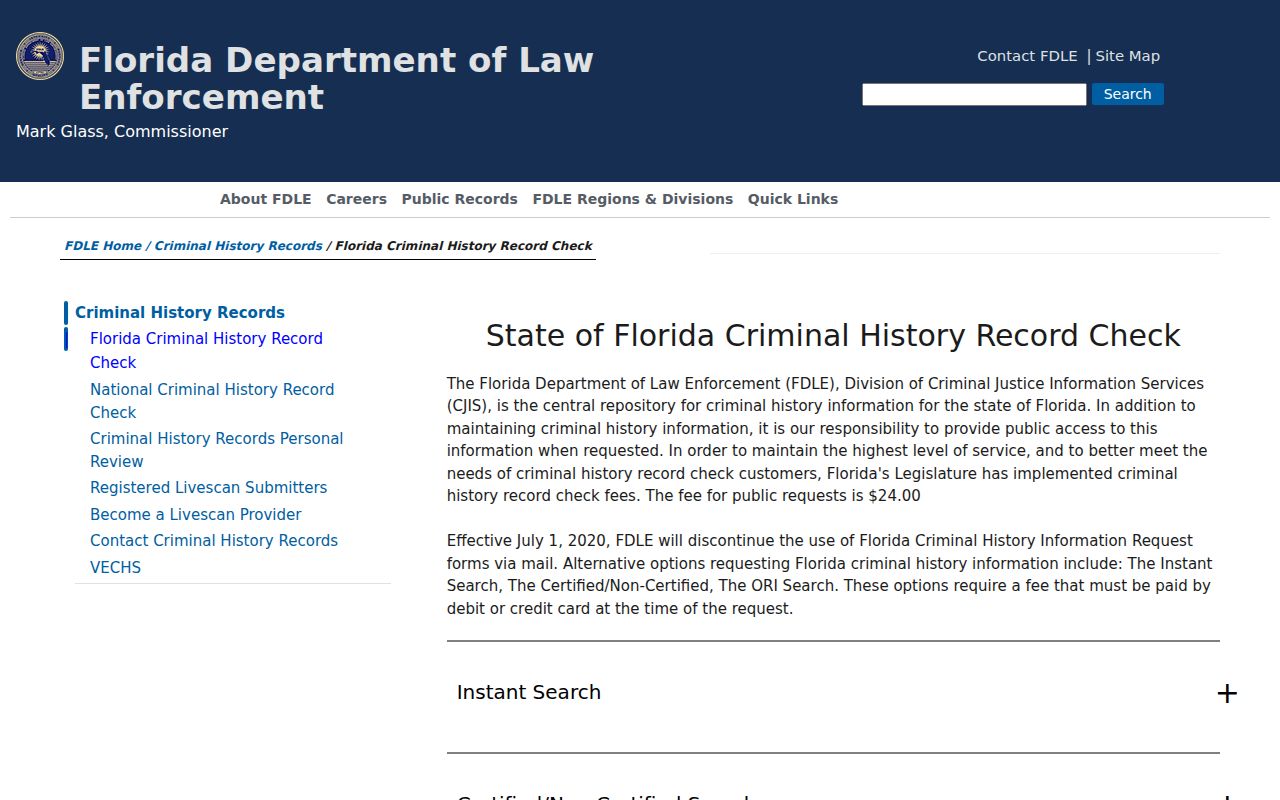
The FDLE product is repository data, not a complete local incident narrative, and it excludes records withheld by sealing, expunction, or other law.
Yulee Is Nassau's Criminal Records Hub
The working center of Nassau County criminal records is the Robert M. Foster Justice Center area in Yulee. The full-service Clerk office at 76347 Veterans Way handles Circuit and County Court records and payments. NCSO Records sits nearby at 77151 Citizens Circle, while the Nassau County Jail and Detention Center is at 76212 Nicholas Cutinha Road. Their proximity does not combine their files.
The Nassau County government portal shows the wider county structure.
General county records go through Records Management at 96135 Nassau Place, Suite 6, but Sheriff's reports should go directly to NCSO and court files to the Clerk.
Nassau Clerk, Yulee
76347 Veterans Way, Yulee, FL 32097
904-548-4600
NCSO Records
77151 Citizens Circle, Yulee, FL 32097
904-548-4009
Monday-Friday, 8 a.m.-5 p.m.
County Records Management
96135 Nassau Place, Suite 6, Yulee, FL 32097
904-530-6090
Types of Criminal Records
A Nassau County criminal record is better understood as a chain of files. Each custodian records one stage and may redact protected material. The arresting agency writes the incident or arrest report; the jail creates intake and custody entries; the Clerk maintains the court case; and FDLE compiles reportable state history.
- Arrest and booking records contain the agency allegation, intake, charge, bond, and custody details.
- Criminal court files contain filed charges, docket events, pleadings, orders, outcomes, and sentences.
- Repository histories arrange reportable Florida events in a chronology tied to identity data.
- Warrant records concern judicial process tracked by the issuing court and law enforcement.
- Custody, supervision, and registry records come from NCSO, FDC, the Commission on Offender Review, and FDLE.
For a deeper distinction between arrest allegations and later results, the county's arrest history resource follows the record from report to booking and court filing.
Searching Nassau Clerk OCRS
The Clerk's OCRS Court Records Search is free for public viewing and is the main online path to Nassau criminal cases. A public user can search by party name or case number. Registration can add criteria such as a date range and case type, but confidential material remains role-gated. The Clerk says registration uses an Online Records User Registration Agreement sent to subscribers@nassauclerk.com and may take one to five business days.
The Nassau Clerk homepage is the official doorway to current court services and records.
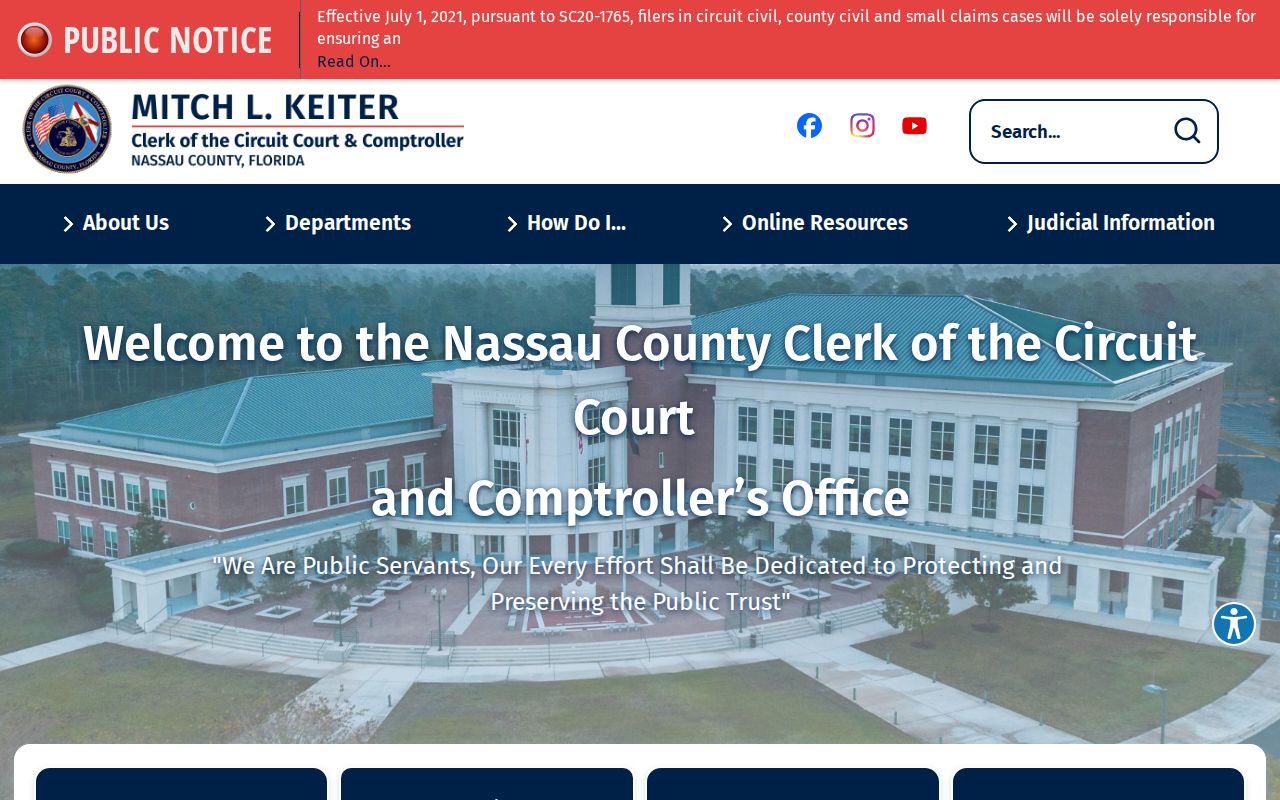
Use OCRS to confirm the filed case rather than assuming the charge shown at booking remained unchanged.
| Party name | Useful when no case number is known; test accurate spelling and permitted variants. |
|---|---|
| Case number | The strongest direct route to a known Nassau court file. |
| Date range | An added criterion associated with registered access. |
| Case type | Helps narrow results when the registered interface makes it available. |
| Access level | Public records need no account; confidential records remain restricted. |
What a Nassau County Criminal Record Shows
The fields depend on the record. A Florida repository return is chronological, while a Nassau case file centers on a local case number, division, charges, docket, and orders. A booking record emphasizes booking date, bond, and custody. Read each field in that setting.
| Name & Identifiers | Names, aliases, demographic data, and fingerprint or state-identification linkage where the product lawfully provides it. |
|---|---|
| Arrest / Booking Data | Arrest date, agency, initial charge, booking number, bond, and current custody data. |
| Charges & Statutes | Alleged offenses at arrest or charges later filed by the prosecutor, with statute references. |
| Disposition | The recorded result for a charge, such as dismissal, acquittal, conviction, or nolle prosequi. |
| Sentence | The sanction imposed after the relevant judgment, including custody, supervision, or financial obligations. |
| Custody / Supervision | NCSO covers county detention; FDC records state prison and adult felony community supervision. |
- Withhold of adjudication
- A Florida result that withholds formal adjudication despite a plea or finding; it is not a dismissal.
- Nolle prosequi
- The prosecutor's formal choice not to continue a charge.
- Capias
- Court process commanding arrest, often after failure to appear or comply.
- Docket
- The chronological index of filings and court events.
Nassau Criminal Records Fees in Plain Terms
NCSO's published schedule took effect January 1, 2026. The Sheriff's $5 local check covers its Nassau records slice and is not a substitute for FDLE's statewide $24 search. NCSO can also charge for copies, media, certification, or extensive work, and supplies a good-faith estimate when added labor applies.
| Incident, arrest, crash, or letter copy | $0.15 per page, plus postage if mailed. |
|---|---|
| Local NCSO check | $5 per name. |
| Certified NCSO copy | $0.15 per page plus $1 certification. |
| Electronic or ink fingerprints | $5 processing, by appointment Tuesday-Friday. |
| Extensive research, IT, or redaction | $22.81 per hour; a deposit may be required. |
| Clerk copy and certification | $1 per page and $2 per certified document. |
| Clerk manual search | $2 for each year searched. |
The Nassau County Sheriff's Office website provides the official agency starting point.
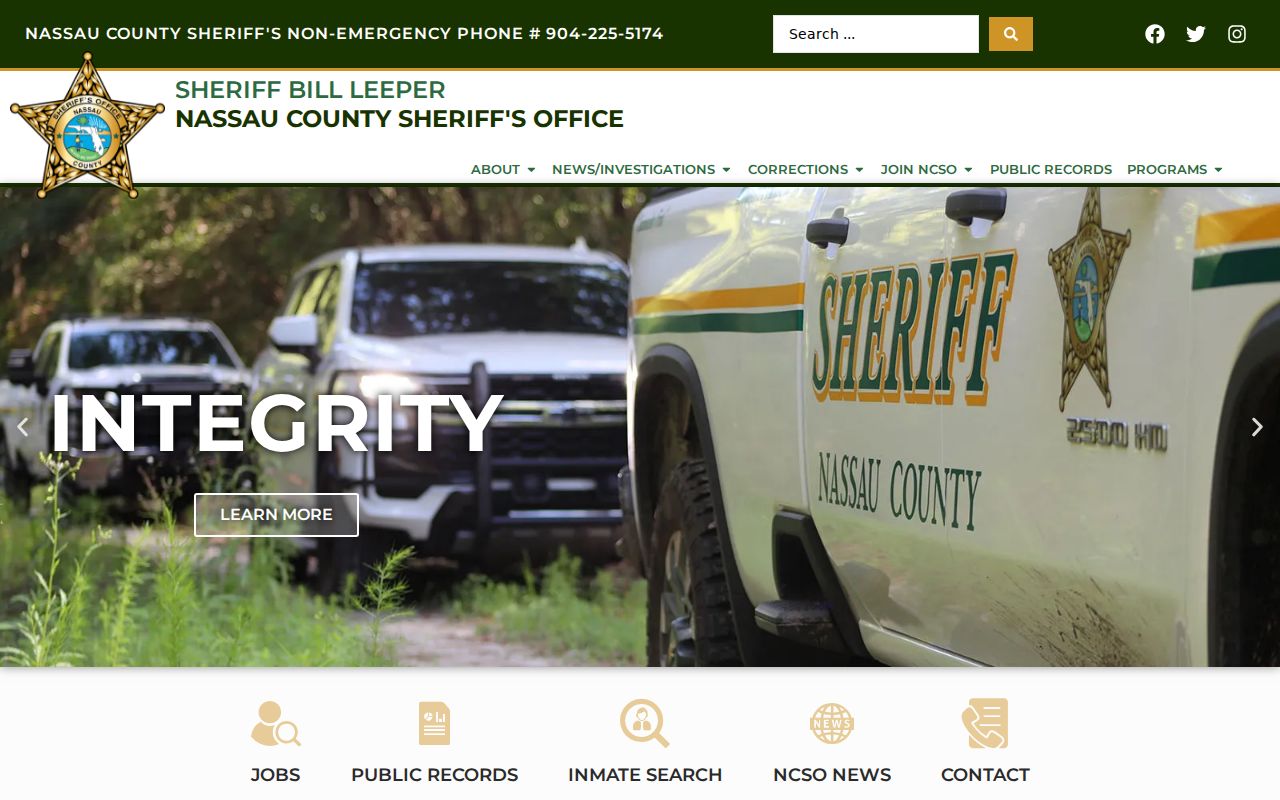
Call Records before ordering a large file so the office can identify likely redactions, media charges, and delivery options.
For records created by ordinary county departments, the Nassau County Records Management page lists online, phone, email, mail, fax, and counter channels.
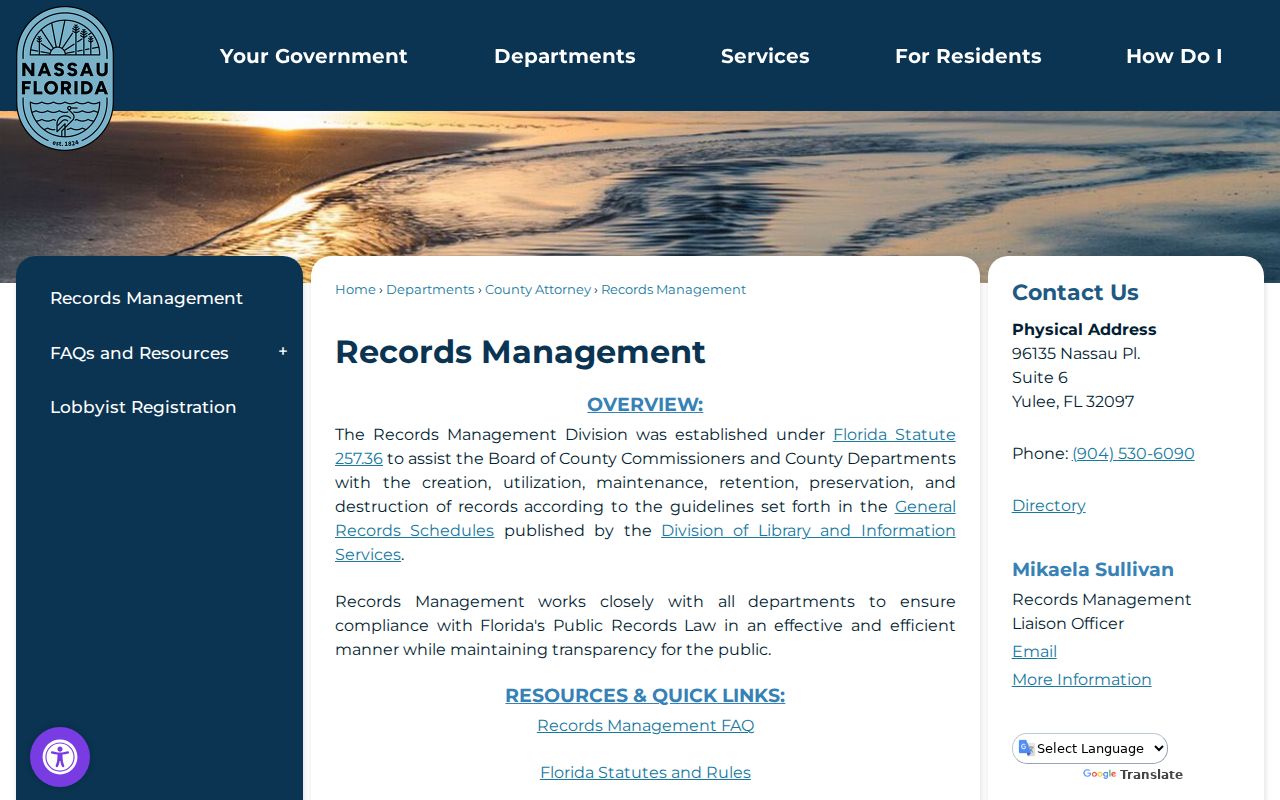
That office reports that most county requests finish within two to three business days, but it routes law-enforcement records to NCSO.
Public Access Laws
Florida Public Records Law allows inspection and copying of nonexempt government records. A request generally need not be written, state a purpose, use special words, or identify the requester. Nassau County accepts administrative requests online, by phone, email, mail, fax, and at the counter. Court records follow judicial access rules, while FDLE disseminates criminal histories through its statutory product.
Key Florida authorities:
Florida Statutes Chapter 119 requires prompt access to nonexempt public records and permits lawful copy and extensive-use charges.
Florida Statutes section 943.053 governs FDLE dissemination and public criminal-history requests.
Florida Statutes section 943.056 provides the personal review and challenge right.
Florida Rule 2.420 controls public access and confidentiality for judicial records.
When Nassau Custody Records Show Nothing
The NCSO Current-Custody Inquiry is limited to people held at the Nassau County Detention Facility now. A person may have been released, transferred, arrested without a county booking, or booked elsewhere. A blank result therefore does not prove there was no arrest or criminal case.
Check OCRS for a filed case, ask the actual arresting agency for its report, and call NCSO Records about historical booking-related material. If the event may have occurred elsewhere in Florida, add FDLE CCHInet. For a state prison or adult felony supervision record after sentence, use FDC Offender Search. Those steps preserve the difference between a current custody snapshot and a criminal history.
VINE offers another official custody-status and notification channel in Florida, but it serves a different purpose from the Clerk's docket. A notification service can help track custody changes; it does not establish the final charge or disposition. Likewise, NCSO jail services such as visitation, mail, and inmate programs relate to the current detention setting, not to the legal outcome. Nassau's facility provides GED preparation and testing, recovery groups, Parenting 101, InsideOut Dad, and faith-based reentry programming. Those programs add context to a custody record without changing what the court file says.
Sealed, Expunged & Restricted
Florida uses both court-ordered sealing and expunction. The processes are not the same. Sealing limits public access while authorized agencies may retain access; expunction generally directs destruction of qualifying records, with a confidential FDLE copy kept under narrow authority. Juvenile, victim, active-investigation, and other protected information may also be confidential or redacted.
A dismissal does not automatically erase the arresting agency's report, booking entry, or repository event. A person ordinarily begins the court-ordered route by seeking an FDLE Certificate of Eligibility and then petitions the court. Eligibility depends on the record and law, so a missing public result should never be treated as proof that a record was expunged.
FDLE's Personal Review process lets a person inspect and challenge their own Florida repository record without an FDLE fee.
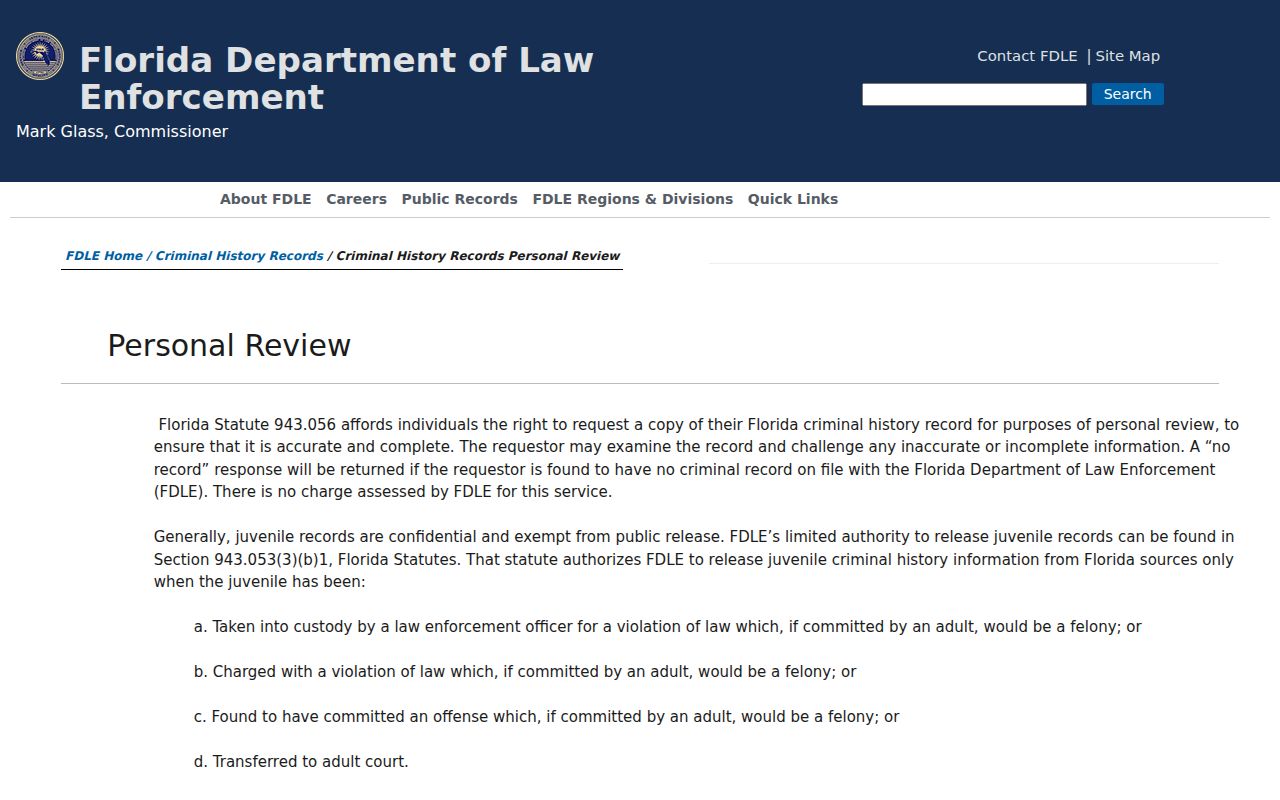
Personal Review requires fingerprints taken by a law-enforcement or criminal-justice agency and is available only to the subject or a designated attorney.
Nassau Criminal Record Fingerprints and Matching
NCSO offers $5 electronic fingerprint processing at 77151 Citizens Circle and $5 ink cards at the detention facility on Nicholas Cutinha Road. Both require an appointment Tuesday-Friday, excluding holidays. Before the appointment, confirm whether the receiving program requires an FDLE-approved LiveScan provider and a specific Originating Agency Identifier. The rolling charge is separate from any state, federal, or vendor fee.
For self-review, fingerprints provide a stronger identity match than a name search. FDLE charges nothing for Personal Review and accepts the form and law-enforcement or criminal-justice fingerprints by mail. CCHInet Instant Search, by contrast, uses name and demographic information and can conflate similar people.
The FDLE Instant Search interface shows the public name-based route.
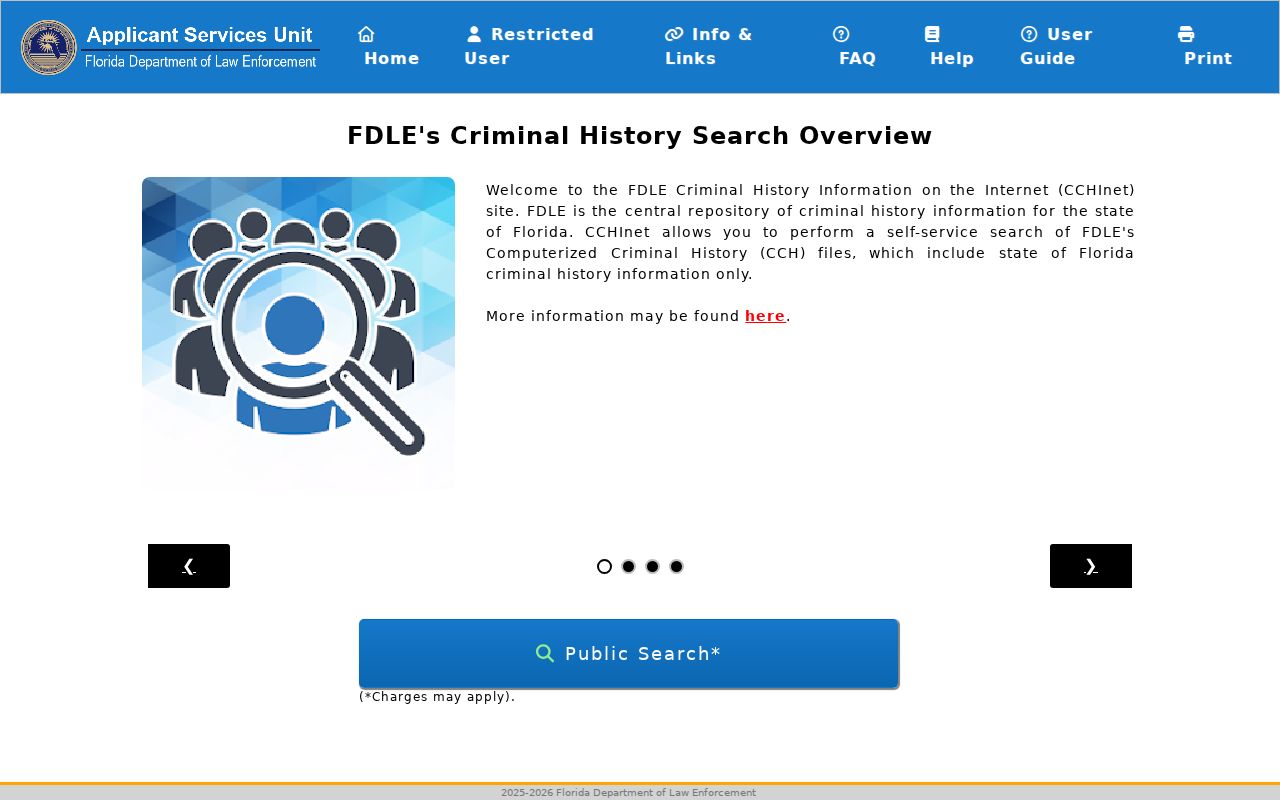
Use the printed or emailed return as a non-certified repository result, then verify a Nassau case through the Clerk when the outcome matters.
Nassau Warrant Records Need Verification
No verified Nassau-only warrant search portal was found. Start with FDLE FCIC Wanted Persons, which refreshes every 24 hours, but do not treat a result or absence as confirmation of current warrant status. Check OCRS for the related case, contact the issuing Nassau County or Circuit Court and Clerk, call NCSO, and request releasable Sheriff's records.
Arrest warrants rest on judicial probable cause. A bench warrant or capias commonly concerns a failure to appear or comply, while search-warrant details may remain operationally restricted. Anyone addressing their own possible warrant should obtain the case and warrant number, ask about bond and status, and verify clearance with both the court docket and agency after the court acts.
The FDLE form accepts a last name of at least two characters and can narrow by first name, middle initial, exact nickname, race, sex, date of birth or age. Results may show aliases, offense, reporting agency and case, warrant date and number, physical descriptors, and last-known address. Its list is capped at 500 results. A broad or common-name match therefore needs careful confirmation through the reporting agency.
Criminal Records by City in Nassau County
Nassau County has three incorporated municipalities. Fernandina Beach Police keeps reports created by its officers, even when NCSO handles the later booking in Yulee. Hilliard and Callahan rely on NCSO for law enforcement, while their town halls hold administrative records. Court prosecutions from all three municipalities route into Nassau's Circuit and County Court structure and OCRS.
Fernandina Beach Criminal History
13,958 · City police reports begin with Fernandina Beach Police; bookings and cases move to county systems.
Hilliard Criminal History
3,127 · NCSO provides law enforcement; OCRS holds filed Nassau court cases.
Callahan Criminal History
1,752 · NCSO handles law enforcement while the Town Clerk holds town administrative files.
The population figures are Florida BEBR estimates for April 1, 2025. Yulee is not included because it is unincorporated, though it is the county's main justice-records hub.
Federal Criminal Records Beyond Nassau County
Nassau County falls within the U.S. District Court for the Middle District of Florida. Federal criminal dockets do not appear in OCRS. PACER is the federal account-based system for docket and document access, while the FBI Identity History Summary is the federal fingerprint-based self-review product. The FBI fee is $18, apart from fingerprint or channeler costs.
The PACER portal is the official federal case-record entry point.
A PACER docket answers a federal court question; it is not a substitute for Nassau OCRS, an NCSO report, or FDLE's Florida repository.